Article
The Lifetime Deal Illusion: Why “Pay Once” Sounds Better Than It Usually Is
This may not make me popular with service providers, but it’s the truth that needs to be understood before dollars are spent. The idea of paying once for an AI service and getting access…
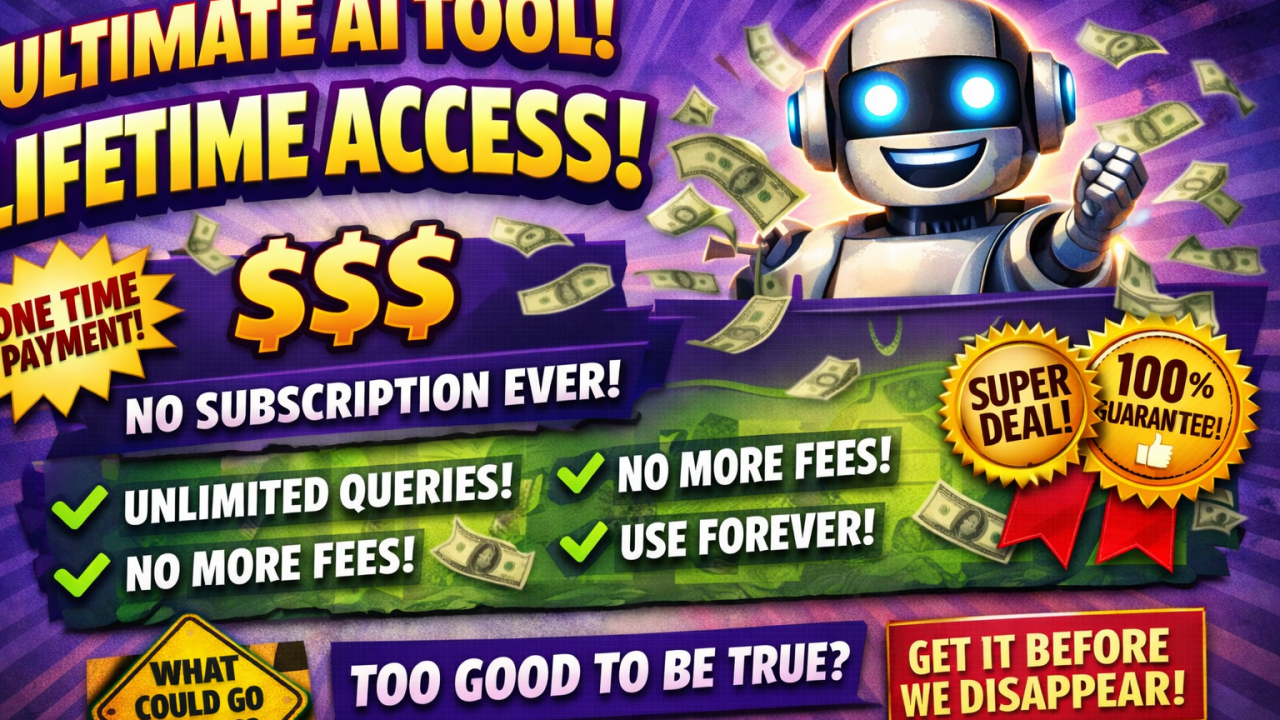
This may not make me popular with service providers, but it’s the truth that needs to be understood before dollars are spent. The idea of paying once for an AI service and getting access forever feels like beating the system. It scratches that same itch as buying software in the early 2000s, when a CD and a license key meant you owned something. The problem is, AI services are not that kind of product, and pretending they are leads to some very predictable outcomes.
At its core, a “pay once” offer is appealing because it removes friction. No monthly decision, no creeping cost, no feeling of being rented access to something you depend on. It promises stability in a world where everything seems to be subscription-based. That emotional appeal is real, and it is exactly why these offers work so well. But the reality underneath is less nostalgic and far more operational.
AI services are not static tools. They are living systems that incur ongoing costs every time you use them. Whether the provider is running local models on their own hardware or calling external APIs, every prompt, every response, every bit of uptime has a cost attached to it. Infrastructure does not become free over time. It ages, it fails, it needs to be replaced, and it certainly needs to be powered. When you pay once and continue to use the service, you are not a completed transaction. You are a continuing expense.
That creates a tension that rarely gets talked about. If a company collects a one-time payment and promises indefinite service, it has taken on an open-ended obligation with a closed-ended revenue stream. That is not inherently impossible, but it is inherently unstable. Something has to give. Either usage stays low, the service quality degrades, the terms quietly shift, or the business model evolves into something that was not originally advertised.
You can see the patterns if you look for them. Many of these offers rely on the assumption that most users will not fully utilize what they purchased. Some quietly introduce tiers, where “lifetime” applies to a basic experience while meaningful functionality moves behind a subscription. Others are buoyed by early-stage funding, using lifetime deals as a way to generate cash and user growth while the real business model is still forming. And in some cases, the service itself is not the product at all. The product is the data, the exposure, or the funnel into something else.
None of this automatically makes a lifetime deal a scam. There are legitimate versions of this model, particularly from smaller developers who are offering tools that do not carry heavy ongoing costs. A lightweight interface, a locally run model, or a narrowly scoped utility can sometimes sustain a one-time payment structure, at least for a meaningful period of time. In those cases, what you are really buying is not “forever,” but a long runway that feels fair for the price.
The distinction that matters is not whether the offer exists, but whether the underlying economics make sense. When evaluating one of these deals, the question to ask is simple, even if the answer is not. How does this provider continue to afford me? If the answer is unclear, vague, or dependent on future growth that has not happened yet, then you are not looking at a stable product. You are looking at a moment in a business lifecycle.
There are also signals in how the offer is framed. If the messaging leans heavily on urgency, scarcity, or the idea that you are getting access to something that will soon be unavailable at any price, that should give you pause. Not because it is inherently deceptive, but because it often indicates that the value proposition is tied more to the sale than to the service. On the other hand, when a provider is transparent about limitations, usage expectations, and what “lifetime” actually means in practical terms, that tends to reflect a model that has at least been thought through.
What makes this dynamic particularly interesting is that it is not always malicious. In many cases, it is optimistic. Founders believe they can grow into sustainability. Developers believe they can keep costs low enough to honor the promise. Early adopters believe they are getting in on something before it becomes mainstream. Sometimes those beliefs align long enough to create real value. Often, they do not.
So where does that leave you as a buyer. It leaves you in a position where the decision is less about price and more about expectations. If you approach a lifetime deal as a permanent solution, you are likely to be disappointed. If you approach it as a discounted, time-bound opportunity with uncertain longevity, you can make a much more rational decision. You are not buying certainty. You are buying access during a phase.
In the end, the phrase “pay once, use forever” is less of a guarantee and more of a story. Sometimes it is a good story with a decent run. Sometimes it ends abruptly. The difference is rarely in the wording of the offer. It is in whether the business behind it has a reason to keep serving you long after your payment is already spent.
And that is the part worth understanding before you click buy.
This article was originally published on LinkedIn.